So more than a decade ago while I was in-between jobs (pay close attention to the manager red flags post) I tried my hand at a simple Arduino solution for using the Konami code in creative ways and I settled upon using it in a way to credit a game without having to add an external button, hang wires outside of the coin door, or make odd use of the coin return button. Its first external name was Konami Kredit, which in hindsight had too many letter “K”s in it and I could not really use Konami in the name like that, anyway.
It worked (sometimes) but it was a bit clunky to use the whole code just for a single credit, it used the larger “standard” Arduino devices (maybe it was even a Mega) and the units cost a bit back then. I lost interest trying to get it working on a different, smaller microcontroller but had problems reliably pulling the coin signal down to GND.
Fast-forward to recent times and I ended up with an excess amount of ATTiny88 boards due to an ordering error and I was looking for ways to make them useful.
So I dusted off the old idea and came up with a solution that allows for either chorded inputs: holding down multiple switches simultaneously; or a simplified version of the Konami Code that only used the joystick-specific part of the pattern (UUDDLRLR). Toss in a small amount of configuration and voila, the CoinerUP! (which is vocalized the same way “Batter Up!” is said at a baseball game) was resurrected.
The CoinerUP! supports selection between different trigger modes that use chorded inputs (i.e. activating 2, 3, or 4 switches simultaneously) or the joystick part of the Konami Code, and a configurable amount of credit signals sent for each trigger event.
Adding a simple transistor in an open collector configuration neatly resolved the lingering “pull strength” issue, which only seems to have gotten worse with the newer hardware.
It is the perfect way to add free-play capabilities to a game without having to add an external button or leave the coin door open where someone can hurt themselves.
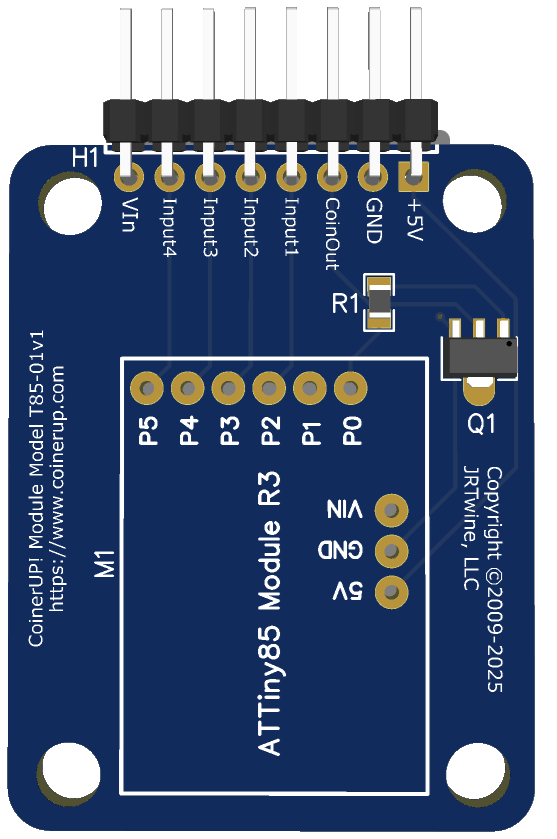
Initial PCB designs that use two different ATTiny8x modules, a fully customizable 88 and a smaller, pre-configured 85 version are shown here:
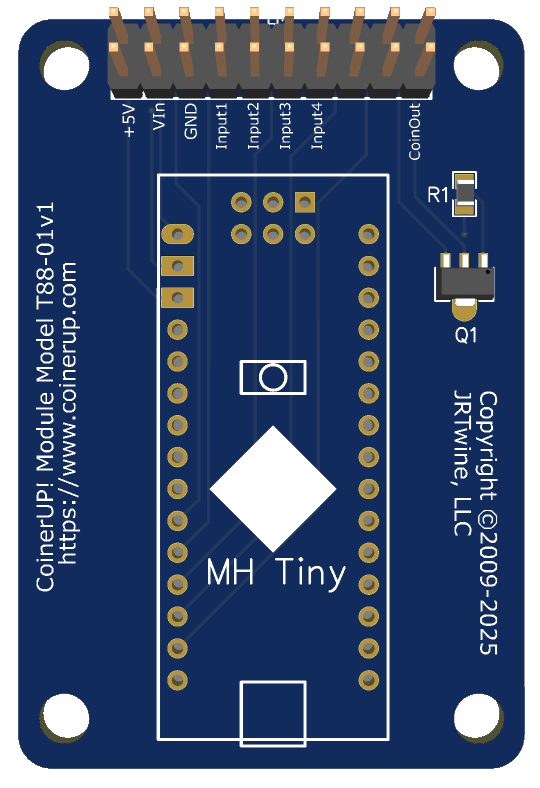
The larger one exposes jumpers on the outer row of pins that configure the input mode, the number of coin pulses that it generates, and the duration of the pulses.
The smaller one is pre-configured for a specific input mode, number of coin pulses, and duration.
The programmed modules will also likely be available for anyone they wants to do the hard-wiring themselves.
Leave a Reply